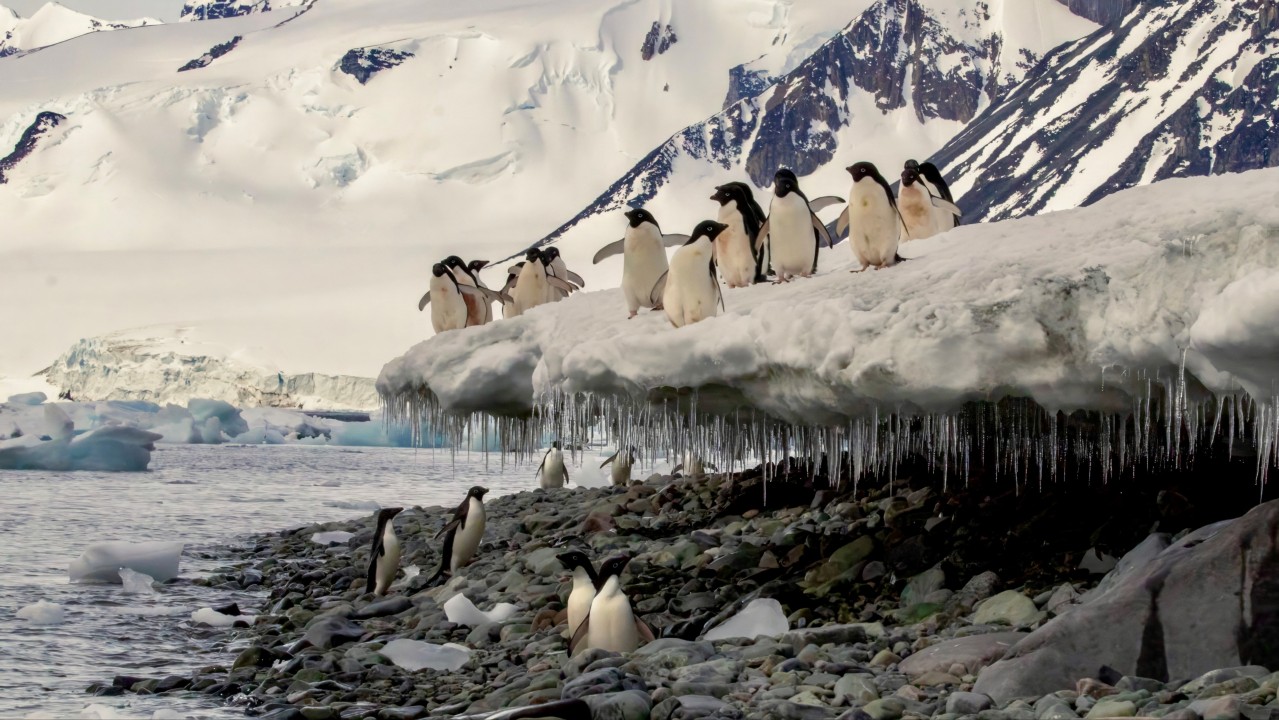
For more than sixty years, the international community answered that question with an unusual act of restraint. Nations agreed to preserve an entire continent for science, peace, and cooperation.
Now the agreement may face its greatest test.
Antarctica has long stood apart from the rivalries that shape the rest of the planet. While nations compete across oceans, markets, and technologies, the southernmost continent has remained governed by a rare international framework that prioritizes peace, scientific collaboration, and environmental protection.
In 1959, twelve nations formalized that vision when they signed the Antarctic Treaty. This diplomatic agreement set aside territorial competition in the most remote place on Earth. What began as a Cold War–era arrangement among a small group of scientific powers has since expanded dramatically. Today, more than fifty countries participate in the Antarctic Treaty system, making it one of the most widely supported international governance frameworks in the world.
Under the treaty system, military activity is prohibited. Nuclear testing is banned. Scientific collaboration is encouraged, and territorial claims are effectively frozen. Few places on Earth have sustained such a durable model of international cooperation.
But the treaty system was never designed to remain unchanged forever.
Beginning in 2048, nations that are parties to the Protocol on Environmental Protection to the Antarctic Treaty will be able to reconsider the prohibition on mineral resource extraction. The clause does not automatically open Antarctica to mining, but it allows for renegotiation.
Yet focusing on that date alone misses the real story.
Nations will shape Antarctica’s strategic landscape long before 2048 arrives. Infrastructure, alliances, and scientific presence will determine negotiating power well before any formal review begins.
In effect, the clock on Antarctica’s future has already begun to run.
The Last Global Commons
Unlike other continents, no single nation owns Antarctica, even though several countries maintain historical territorial claims that the treaty system effectively freezes.
Instead, it operates under an international governance framework in which treaty parties collectively manage scientific activity, environmental protection, and the peaceful use of the continent.
In many ways, Antarctica represents one of humanity’s last functioning global commons. The treaty established a system where scientific discovery took precedence over territorial control and resource extraction.
Across the planet, competition for land, minerals, energy, and strategic advantage continues to intensify. From the seabed to outer space, nations are exploring how to govern shared resources amid growing demand.
Antarctica, therefore, represents more than a frozen continent. It represents a test case for whether humanity can manage shared planetary systems cooperatively.
If the treaty system weakens, the consequences will extend far beyond the Antarctic ice.
A Climate Regulator for the Entire Planet
Antarctica’s significance is not only political. It is planetary.
The continent sits at the center of one of the most powerful climate systems on Earth.
Surrounding Antarctica is the Antarctic Circumpolar Current, the world’s strongest ocean current. Flowing uninterrupted around the continent, it connects the Atlantic, Pacific, and Indian Oceans while redistributing heat, carbon, and nutrients across the planet.
Driven by powerful westerly winds that sweep around the Southern Hemisphere, this current acts as a planetary mixing system. It helps regulate the global ocean conveyor belt. This circulation moves warm water toward the poles and cold water toward the equator. In doing so, it stabilizes global temperature patterns and shapes weather systems far beyond the polar regions.
The Southern Ocean also plays a central role in regulating Earth’s climate. Cold, dense Antarctic waters sink to the ocean floor and spread northward through the world’s ocean basins, driving deep ocean circulation.
At the same time, the Southern Ocean absorbs enormous amounts of excess heat and carbon dioxide from the atmosphere, making it one of the planet’s most important buffers against global warming. Scientists estimate that it absorbs a disproportionate share of the heat produced by human-driven climate change.
Together, these oceanic and atmospheric systems make Antarctica a central engine of the global climate. Changes in Antarctic ice, ocean circulation, or wind patterns can ripple outward across the planet, influencing sea levels, storm systems, rainfall patterns, and temperature stability on multiple continents.
Scientists closely monitor several glaciers within the Antarctic ice sheet that could become unstable in the coming decades. One example is Thwaites Glacier, a massive ice formation whose long-term collapse could significantly accelerate global sea level rise.
Even partial destabilization of Antarctic ice could reshape coastlines around the world. Major cities, infrastructure systems, and entire regions would face rising water levels and costly adaptation.
Antarctica is therefore not simply a remote scientific outpost. It is one of the primary regulators of Earth’s climate.
Because Antarctica plays this planetary role, decisions about governing it reach far beyond territorial politics or scientific research. They influence the stability of the climate systems that support economies, ecosystems, and societies worldwide.
The Strategic Interest Beneath the Ice
While environmental concerns dominate much of the public discussion, Antarctica also contains profound geological mysteries. Beneath kilometers of ice lie ancient rock formations that may contain deposits of iron, copper, uranium, and rare-earth elements, resources increasingly critical to modern technology, advanced computing, and the energy systems that power them.
The Protocol on Environmental Protection to the Antarctic Treaty prohibits mineral extraction and bans resource activity on the continent.
Yet technological advances continue to improve scientists’ ability to map subglacial terrain and understand the geological structures hidden beneath Antarctica’s ice sheet. Satellite sensing, autonomous exploration technologies, and improved polar logistics are steadily revealing once inaccessible terrain.
At the same time, global demand for critical minerals used in batteries, electronics, advanced manufacturing, and large-scale computing systems continues to rise rapidly. The technologies shaping economic and military power—from electrified infrastructure to artificial intelligence—depend on vast quantities of these minerals. As nations search for secure supplies, regions once considered unreachable are increasingly factored into strategic calculations.
In this sense, Antarctica sits at the intersection of two powerful forces: technological competition and planetary stewardship.
For six decades, the Antarctic Treaty system preserved the continent as a shared scientific laboratory rather than a frontier for national exploitation. But as technological capabilities expand and resource competition intensifies, the pressures on the continent are likely to grow.
The deeper story beneath the ice is therefore not only geological. Antarctica may become one of the first places where humanity must decide whether technological competition, driven by demand for energy, minerals, and computing power, ultimately overrides its commitment to preserving one of the planet’s last great global commons.
The challenge is not simply whether resources exist beneath Antarctica’s ice.
It is whether the international community will maintain the political will to leave them there.
Lessons from the Arctic
To understand what may happen in Antarctica, one needs only look north.
In the Arctic Ocean, rising temperatures and retreating sea ice have opened new shipping routes and expanded access to oil, gas, and mineral resources. As a result, Arctic nations have increased their presence, built infrastructure, and asserted competing territorial claims.
Military installations have expanded, energy exploration has accelerated, and strategic competition has intensified.
The Arctic illustrates how quickly environmental change and technological capability can transform a remote region into a geopolitical frontier.
Only a few decades ago, nations viewed the Arctic primarily as a scientific and environmental domain. Today, it has become a region of growing strategic interest where shipping routes, resource deposits, and national security concerns intersect.
Antarctica has so far avoided that trajectory because of the strength of the Antarctic Treaty system, which froze territorial claims and prohibited military activity on the continent.
Yet the forces that reshaped the Arctic are beginning to appear in the south. Technological advances are making polar regions easier to access. Global demand for minerals and energy continues to grow. Nations are expanding research infrastructure and logistical capabilities across Antarctica.
The lesson from the Arctic is not that conflict is inevitable, but that when technological capability and economic incentives align, even the most remote regions of the planet can quickly become arenas of geopolitical competition.
Antarctica remains different. Its treaty system still holds, and its culture of scientific collaboration remains strong. But history suggests such conditions rarely remain unchanged.
Without proactive leadership and renewed international commitment, Antarctica could eventually follow a similar path, shifting from a shared scientific domain to a contested strategic frontier.
The Infrastructure of Influence
Even under the current treaty system, nations are quietly strengthening their Antarctic presence.
Research stations, logistical hubs, airstrips, satellite networks, and icebreaker fleets represent long-term investments in polar capability. They support scientific discovery while building enduring operational capacity in one of the most remote regions on Earth.
The United States maintains a major research presence through facilities such as McMurdo Station and Amundsen–Scott South Pole Station. Other nations have expanded their own research stations, transportation corridors, and logistical networks across the continent.
Today, these installations operate under the banner of science.
But infrastructure has always carried strategic weight.
Operating year-round in Antarctica requires ships, aircraft, energy systems, communications networks, and supply chains that only a handful of nations can sustain. Those capabilities develop only through sustained investment and operational experience over the years.
In most regions of the world, presence precedes power. Countries that build infrastructure, master the environment, and maintain reliable access often shape the rules that follow.
Antarctica is no exception.
If the treaty framework evolves in the coming decades, the nations with the strongest logistical and scientific footprint will hold disproportionate influence in determining what comes next.
Research stations serve as instruments of cooperation today. Still, they also represent a quiet form of positioning for a future yet to be negotiated.
That positioning is already underway.
The uncomfortable truth is that while much of the world still views Antarctica as a distant scientific preserve, nations are already laying the foundations of geopolitical influence across the ice.
The Decision Before the Crisis
One reason the Antarctic Treaty system remains extraordinary is its durability. The agreement survived the Cold War, periods of geopolitical confrontation, and dramatic shifts in global power.
Both the United States and the Soviet Union were original signatories, and their successors continue to participate today.
Few international governance systems have endured through such geopolitical upheaval while preserving their core principles of demilitarization, scientific cooperation, and environmental protection.
But durability is not permanence.
Over time, global change forces every governance system to confront a world different from the one its designers imagined.
Antarctica may now be approaching such a moment.
The pressures are already visible. Technology is advancing. Demand for resources is rising. Strategic competition among nations is intensifying.
Yet the future of Antarctica remains one of the rare global issues where the warning signs appear well before the crisis.
The timeline is clear.
The real question is whether humanity will act while there is still time to shape the outcome.
Antarctica is more than a continent of ice. It is a test of whether the international community can exercise foresight rather than react to conflict after it begins.
The original Antarctic Treaty proved that cooperation was possible even in an era defined by rivalry.
Now the world faces a different question.
Will the nations of the twenty-first century prove capable of the same restraint?
Will we protect the last continent governed as a shared global commons?
Or will Antarctica become the next arena where technological ambition, resource demand, and the relentless pursuit of strategic advantage reshape a continent that humanity once agreed to leave untouched?
And perhaps the hardest question of all:
If humanity cannot preserve one continent that belongs to no one, what hope is there for governing the rest of the planet together?