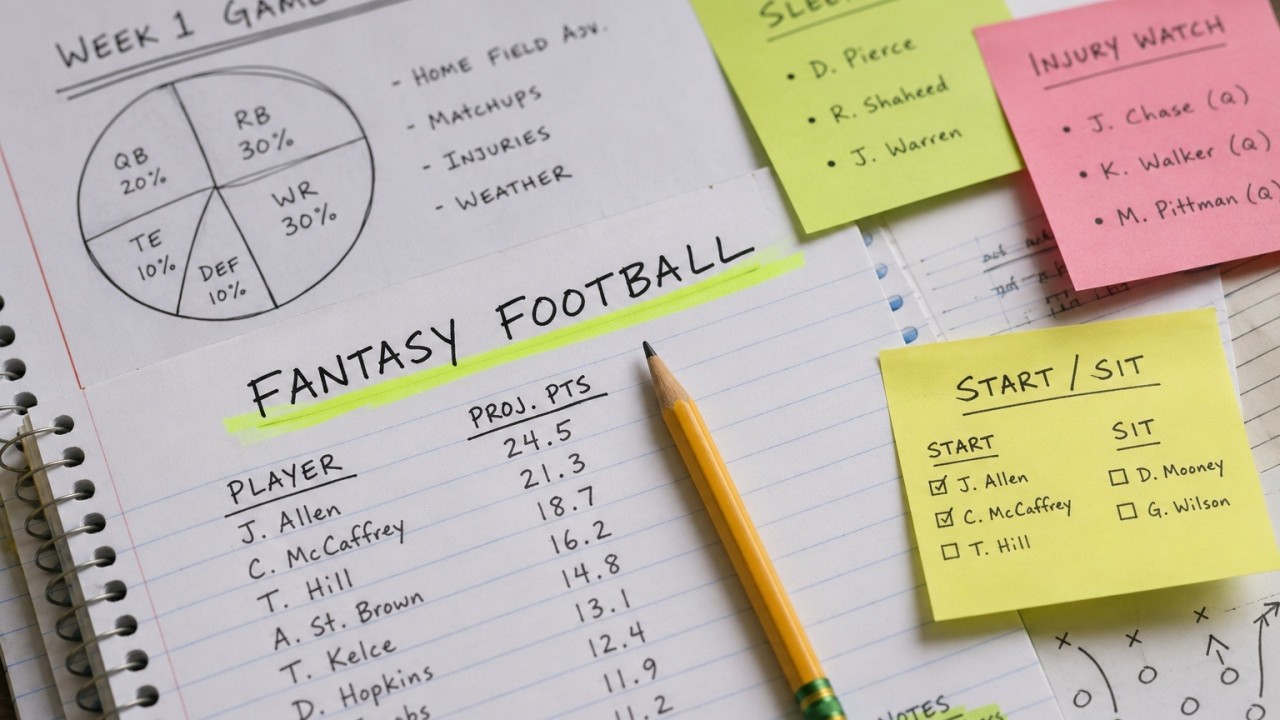
Long before Sunday, fantasy football managers have begun gathering evidence.
They listen to podcasts arguing over matchups, injuries, weather, coaching decisions, and the players most likely to outperform expectations. They read rankings, follow injury reports, study projections, and search for the overlooked player who might change everything.
Thursday Night Football doesn’t settle anything. It simply sends everyone back to rethink the rest of the week.
By Sunday morning, uncertainty feels almost conquered. The lineup is set. The research is complete. Every new statistic, projection, and opinion makes the lineup feel just a little more certain. For a few hours, uncertainty feels manageable.
At kickoff, millions of people are convinced they’ve done everything possible to make the right decisions.
Reality begins revealing information no one had on Sunday morning.
Then the games begin.
The backup running back no one started scores three touchdowns. The first-round pick leaves with an injury before halftime. The defense expected to dominate gives up forty points, and the player on your bench outscores every starter on your roster. Carefully constructed lineups unravel while the players you almost started become the stars of the week. For a moment, you’re convinced you should have seen it coming.
By Sunday evening, millions of intelligent people are asking the same question: How could we have known so much and still been so wrong?
Perhaps the better question is this:
Why do we keep believing that one more piece of information will finally make uncertainty disappear?
The Information Trap
Every season, fantasy football platforms add more data. More projections. More player metrics. More matchup analysis. More expert opinions. Every year we know more than we did the year before. We also become a little more confident that this time we’ll get it right.
Most managers begin with access to nearly the same information. They see the same injury reports, projections, rankings, weather forecasts, and expert analysis. Some spend hours searching for an edge. Others trust instinct. Some recognize patterns others miss. Some make consistently better decisions. Better information usually leads to better decisions. It just doesn’t guarantee better Sundays.
The analysis wasn’t necessarily wrong. The outcome simply refused to cooperate.
No manager gets every player they want. Every lineup is built from constraints, compromises, and uncertainty. Every decision is made with the players you have, not the players you wish you had. By Sunday afternoon, every manager discovers which compromises mattered.
Maybe that’s why the research never really stops. Sunday’s surprises become Monday’s questions, and before long we’re gathering evidence all over again. Somehow, it always feels as though one more week of information will finally be enough.
Judging Decisions
Sometimes the right decision fails. Sometimes the wrong decision succeeds. A running back is injured on the opening drive. An unexpected storm changes the course of a game. A backup receiver catches two long touchdown passes after the starter leaves with a concussion. None of it was impossible. None of it was predictable enough to build a lineup around.
After enough Sundays, something begins to change. Winning still matters, but so does understanding why you won or lost.
You begin replaying your decisions. Did I miss something? Was my reasoning flawed? Or am I judging yesterday’s decision with information I didn’t have yesterday morning? Perhaps this was simply one outcome among many that had always been possible.
Statisticians have a word for it: variance. It reminds us that probability and outcome are never quite the same thing.
Imagine if every thoughtful decision always worked exactly as expected. How long would it take before we stopped questioning ourselves?
Variance keeps us searching.
Certainty tells us to stop.
Every Sunday delivers feedback. Sometimes it confirms what you believed. More often than we’d like, it challenges assumptions we didn’t even realize we were making.
The managers who improve aren’t necessarily the ones who predict the most winners. They’re the ones who resist the temptation to defend last week’s decisions simply because they were theirs. Instead, they let this week’s games reshape next week’s thinking.
Investors confront it when markets ignore their forecasts. Scientists encounter it when experiments refuse to support a promising theory. Physicians see it when patients respond differently to the same treatment. Leaders experience it when carefully crafted strategies collide with reality.
Reality keeps offering new evidence. Whether we learn from it depends on whether we’re willing to change our minds.
When the final whistle blows, one question remains. Not whether you won. Not whether you lost. What did this week teach you that should change the way you think next week?
One More Chance
By Sunday night, most fantasy football managers already know whether they’ve won or lost.
Yet millions are still watching Monday Night Football.
For some, there is still one more chance to pull out a victory. One more touchdown. One more reception. One more field goal. For others, the outcome has already been decided, but they watch anyway.
The game they’re watching is no longer the same one they started on Sunday morning.
A rookie earns more playing time than expected. A quarterback begins trusting a new receiver. An injury reshapes next week’s matchups. Every play quietly changes the way next week’s decisions will be made.
Without realizing it, next week has already begun.
Some people spend the week defending last Sunday’s decisions. Others spend it rethinking them. The difference isn’t how often they’re right. It’s what they do after they’re wrong. By the time next Sunday arrives, those are no longer the same managers.
Experience doesn’t automatically make us wiser. Feedback is what turns experience into wisdom but only if we’re willing to change our minds.
By Tuesday, the injury reports are open again. The projections are updated. The debates begin all over. Somehow, hope returns remarkably quickly.
Not because uncertainty has disappeared.
Because next Sunday is another chance to ask better questions.