Much of the current conversation about AI is focused on what it will eventually be able to do.
How powerful will it become? What jobs will it replace? Which companies will win? Which countries will dominate? How should it be regulated?
Important questions. But they may be focused on the most visible part of the change rather than the change itself.
The chemist Ilya Prigogine spent much of his career studying what happens when systems are pushed far from equilibrium. Under certain conditions, instability does not simply produce collapse. New structures can emerge. The system reorganizes, sometimes into forms that could not be understood by examining the individual parts.
AI may be creating the conditions for something similar.
Today, most AI activity still begins with people. Someone asks a question. A machine searches, calculates, writes, or acts. The result comes back to a person.
That structure is already changing.
AI systems are beginning to interact with other AI systems. Google originally developed an open protocol called Agent2Agent, or A2A, to let independent AI agents discover one another, communicate, delegate tasks, and collaborate. The protocol has since moved into the Agentic AI Foundation. Agents can search for information, call other services, evaluate alternatives, purchase resources, and carry out increasingly complex chains of activity. Much of this still originates with a human request. But between that request and the eventual result, machines may take on a growing amount of activity.
At some point, the more important question may no longer be how intelligent an individual AI becomes. It may be what emerges from the interaction among millions, perhaps eventually billions, of humans and machines.
A neuron is not a mind. A person is not a market. A computer is not the internet. In each case, something different emerges through connections among the parts.
Perhaps AI is not the transformation. Perhaps it is one of the forces pushing an already changing human system toward its next form of organization.
Something Happens Between the Parts
Connectivity has always done more than connect. New connections create interactions and behaviors that weren’t there before.
That may be what deserves watching now. Not simply what humans do with AI, or even what individual AI systems can do, but what begins to emerge as humans, machines, businesses, markets and institutions form new constellations of interaction.
Perhaps the next leap isn’t simply more powerful artificial intelligence. Perhaps it is what begins to emerge between intelligences.
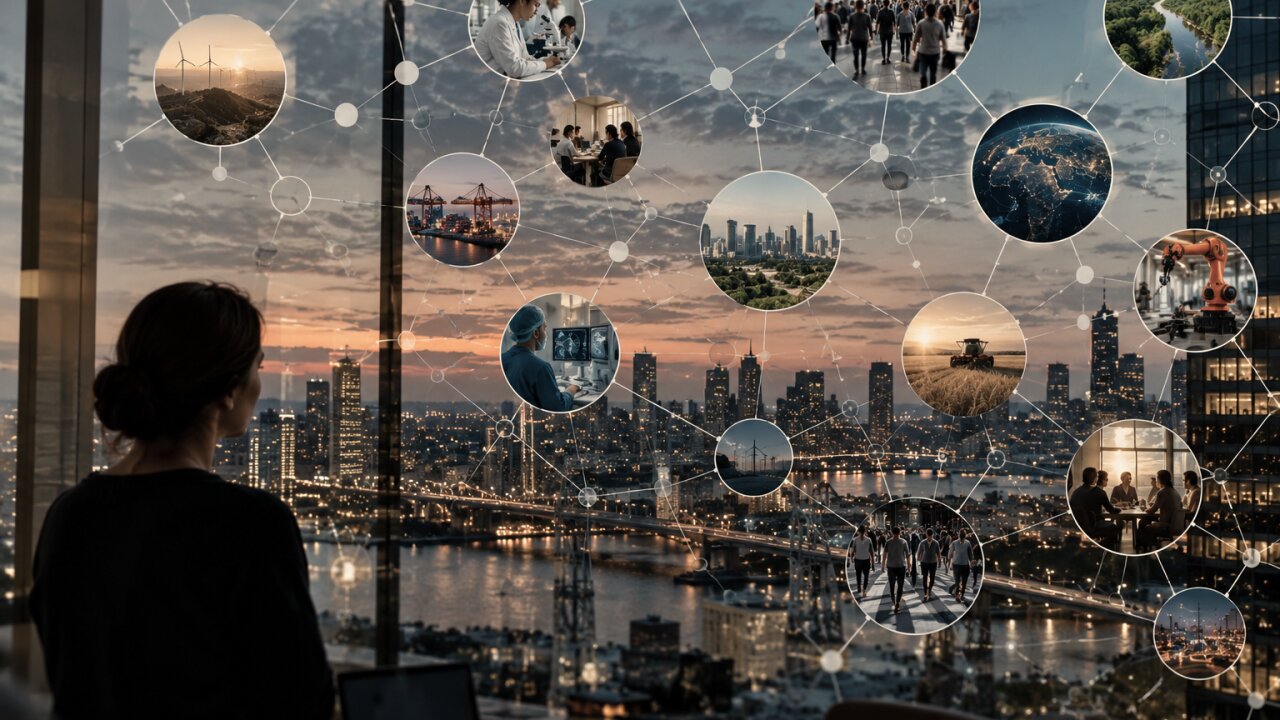
Not a superintelligent machine sitting somewhere with all the answers, but something distributed across billions of interactions among people, AI systems, businesses, markets, scientific institutions, governments, sensors, databases and physical infrastructure.
We already live inside systems like this. No single person understands the global economy. Yet prices, shortages, investment, demand, production, and human behavior continuously interact and move resources.
No individual created the internet as it exists today. Billions of decisions, inventions, businesses, communities, conflicts and connections continually reshape it.
AI introduces something different. Machines are beginning to participate more actively in the interactions themselves. As the number and speed of those interactions increase, so does the possibility of consequences we did not anticipate.
An error in one system may create information another system acts on. That action may signal others, which respond in turn. Markets could move. Resources could shift. Decisions could be made. By the time a person recognizes what is happening, the original error may be buried several interactions deep.
The same connections that accelerate discovery could also do the same for misinformation, manipulation, or instability. Systems designed independently for perfectly reasonable purposes could interact in ways none of their creators anticipated.
As machines become more active, we may also find ourselves seeing the outcome without understanding what produced it. More intelligence in the system may not mean more understanding by the people living inside it.
When Failure Becomes a Signal
Consider something as ordinary as an unmet need.
Innovation has traditionally required someone to recognize it. An entrepreneur notices customers struggling with a problem. A scientist sees an anomaly. A physician encounters patients whose symptoms don’t fit an established pattern. Someone watches people improvise a workaround and realizes they are trying to solve a problem no existing product addresses.
Someone sees what others have missed.
But imagine millions of AI agents attempting to accomplish things for people and organizations. Some succeed while others repeatedly encounter the same obstacle. They search for something that doesn’t exist, combine several products because no single one solves the problem, or create similar workarounds.
One failed attempt means very little. A million similar failures mean something. Together, they begin to reveal a pattern.
No customer survey identified the need. No researcher set out to study it. No entrepreneur necessarily recognized the opportunity.
What happens if other parts of the network begin responding to that pattern?
Researchers may find connections to work underway somewhere else. Companies may see demand that wasn’t visible before. Someone may recognize an opportunity no one had been looking for.
No single participant saw the whole thing. The system did.
But recognizing a pattern and deciding what to do with it are different. The same repeated behavior that reveals an unmet need could reveal a vulnerability. The same signal that points toward a solution could also point toward something that can be exploited.
What Will the System See?
None of this means the system becomes conscious. Nor does pattern recognition become curiosity simply because it operates at enormous scale.
Humans wander outside the question we were asked. Something seemingly irrelevant catches our attention. An experience from decades ago suddenly connects to something happening today. Curiosity can take us places we had no reason to go.
But humans are also limited by what we can see.
A researcher sees one part of a problem. A business sees its customers. A government sees the data it collects. Each of us experiences only a small part of an enormous interconnected world.
A network containing billions of human and machine interactions could see different patterns.
Not necessarily the future, but perhaps change while it is still taking shape.
The future does not suddenly appear one morning. It accumulates through weak signals, strange connections, unresolved problems, changing behaviors, experiments, failures, and ideas that initially seem unrelated.
AI may allow machines not simply to carry information across the network, but increasingly to interpret it, respond to it, and interact with one another. Those interactions create new information. Failures become signals. Unexpected connections may reveal something difficult to see from inside any one part of the system.
It may simply be another layer of complexity. Or something different may be beginning to form through the interactions themselves.
Prigogine’s work does not tell us what that new organization will be, or whether it will be better. But his work reminds us that when complex systems are pushed far from their existing equilibrium, looking only at the individual parts may cause us to miss what is forming through their interaction.
And if something new emerges from all these interactions, there may be no one who designed it or fully understands it.
Maybe we are looking too closely at the machines.
The question may not only be how intelligent AI becomes, but what is beginning to emerge between all of us.
And what happens when that system begins seeing and acting on things none of its individual members can see alone?