I woke before sunrise in Kigali, Rwanda, laced up my running shoes, and slipped quietly into the warm, humid morning air.
The city was stretching awake. The first rays of sunlight spilled over Kigali’s green hills as people began opening their shops. There weren’t continuous sidewalks like I was used to at home, just short stretches of cracked concrete broken by patches of packed red earth. I picked my way between them as the neighborhood came to life.
A butcher arranged the day’s first cuts of meat. Next door, a mechanic was already bent over a motorcycle with half its engine scattered across the ground. Tiny storefronts displayed soft drinks, biscuits, and, for reasons I’ve never understood, Pringles. No matter where I travel in the world, someone always seems to be selling Pringles.
Small motorcycles buzzed past carrying two, sometimes three, passengers on their way to work. Worn buses lumbered through the streets, already so full that people stood shoulder to shoulder in the aisles. Women swept the dust from in front of their businesses. At the same time, children in neatly pressed school uniforms, backpacks bouncing behind them, walked toward school.
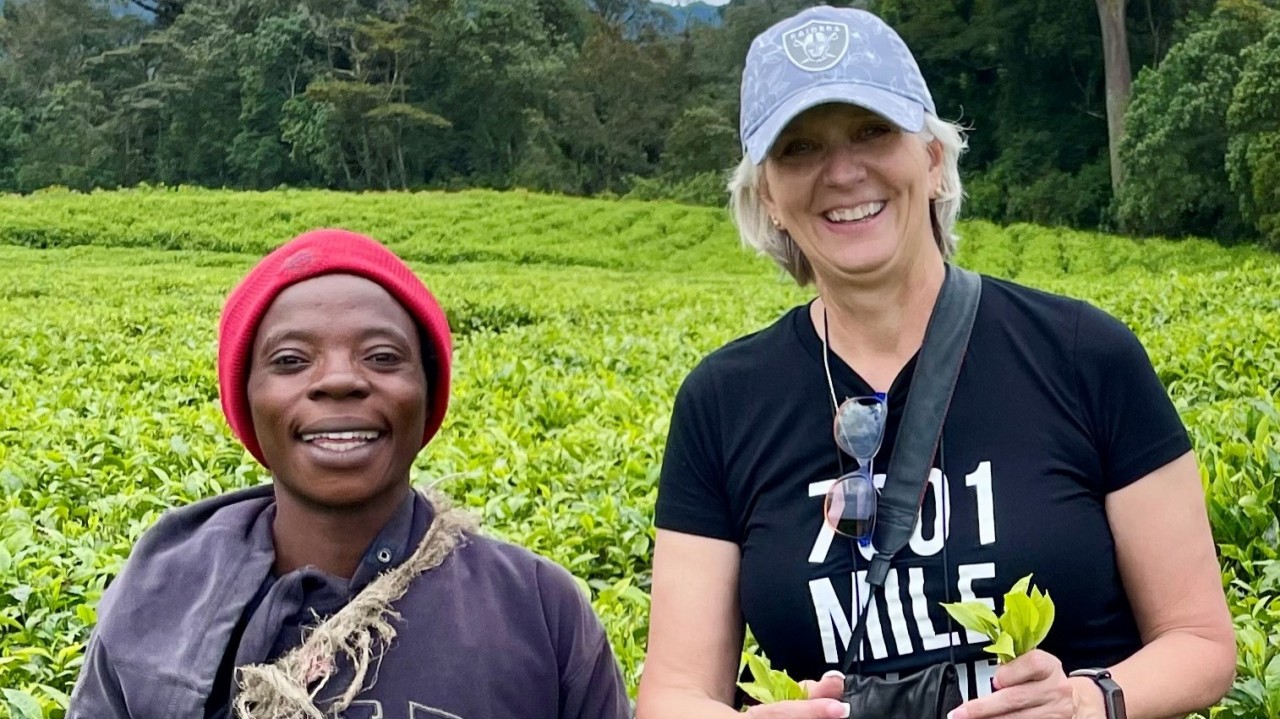
At five foot ten, with pale skin and blond hair tucked beneath a Las Vegas Raiders cap, wearing running tights and a faded Rolling Stones T-shirt, I wasn’t exactly blending in.
The first children I passed stopped and stared.
A few little girls giggled.
Some of the boys pointed, shouted something in Kinyarwanda that I didn’t understand, and laughed.
I smiled and waved.
A few hundred yards later, I heard footsteps behind me.
I glanced over my shoulder.
Two little girls had decided to run with me.
They were laughing so hard they could barely keep pace.
Soon there were four.
Then six.
Then a whole pack of children, sprinting, laughing, pointing, daring one another to catch the strange woman running through their neighborhood.
And then something happened I’ll never forget.
One of the mothers joined us.
She was wearing a skirt and sandals, hardly what anyone would choose for a morning run. Yet she took off effortlessly, smiling from ear to ear as she caught up with the children.
What struck me wasn’t how fast she was.
It was the look on her children’s faces.
They looked surprised, as if they had never seen their mother run.
Their surprise quickly turned into delight as they laughed, teased her, and tried desperately to outrun her.
For the next quarter mile, we ran together through the streets of Kigali.
No one spoke.
We shared no common language.
When we reached the road leading to the school, the children slowed to a stop. One by one, they came over with huge smiles, holding out tiny fists for a bump before turning toward the schoolyard.
Their mother paused for just a moment.
She smiled, gave me a small nod, and then took off after them, her skirt swaying and sandals slapping against the pavement as the children laughed and tried once again to outrun her.
I stood there watching them disappear around the corner.
I couldn’t help but smile.
I have a son who has never quite understood my obsession with running, either.
Apparently, that mystery isn’t unique to my family.
But I still think about that run.
Not because of where I was.
Because of who I met.
We Are Wired for Connection
Before we understand one another’s language, we recognize a smile. Before we know someone’s history, we can hear laughter. We instinctively understand curiosity, kindness, generosity, and joy. These are among the oldest forms of communication we possess. They require no translation because they are woven into our humanity.
Throughout history, human progress has depended on connection. Long before there were books, classrooms, or technologies, knowledge moved from one person to another. Around campfires, across dinner tables, through apprenticeships, marketplaces, families, and friendships, people shared stories, skills, traditions, and hard-earned wisdom. Civilization advanced because human beings learned together.
That has never changed.
Technology has expanded our ability to find one another. It did not invent our need to connect. It simply expanded our ability to connect across time, distance, and culture.
Every generation inherits knowledge from those who came before. Every meaningful conversation leaves us carrying something we didn’t bring into it.
Information helps us navigate the world. People teach us how to see it.
That has always been humanity’s greatest advantage.
A Larger World
Every encounter with people whose lives differ from our own has the potential to challenge an assumption we didn’t realize we held.
Sometimes another culture changes how we think about leadership. Sometimes family. Sometimes success itself. The subject hardly matters. What changes is the realization that the world contains more than one sensible answer.
Places introduce us.
People teach us.
Every person sees a world we cannot.
Every meaningful conversation reminds us that our experience is only one version of the world. Every culture reveals that what feels “normal” is often simply what is familiar.
The lesson is not about where we go. It is about how willing we are to be changed by the people we meet.
Every person we meet lets us borrow a way of seeing the world we could never discover on our own.
That may be one of the greatest gifts another person can offer us: a world larger than the one we could have discovered alone.
The Journey Home
Somewhere in Kigali, there are now teenagers who probably don’t remember the strange woman in the Rolling Stones T-shirt.
I doubt they’ll ever know how much they taught her.
In a few weeks, I’ll pack another suitcase and set off once again. As always, I’ll read about the history of the places I’ll visit. I’ll study maps, learn a few words in another language, and make a list of the sites I hope to experience. Preparation matters. It deepens appreciation for where you’re going.
But experience has taught me that the moments I remember most are rarely the ones I planned.
They arrive unexpectedly.
A conversation over coffee with someone whose life has taken a completely different path from mine. A meal shared with strangers who become friends. A question that challenges an assumption I didn’t realize I was carrying. A story that reshapes how I understand a country’s past or its hopes for the future. Sometimes it’s as simple as a group of laughing children inviting themselves into a stranger’s morning run.
When I look back on my travels, it isn’t the places I remember most. It’s the people.
Every journey reminds me that the greatest gift we bring home isn’t a photograph, a souvenir, or another stamp in a passport.
It is the quiet realization that no matter how much of the world we’ve seen, someone else can still show us a part we’ve never noticed.
The more worlds we are willing to borrow from, the richer our own becomes.