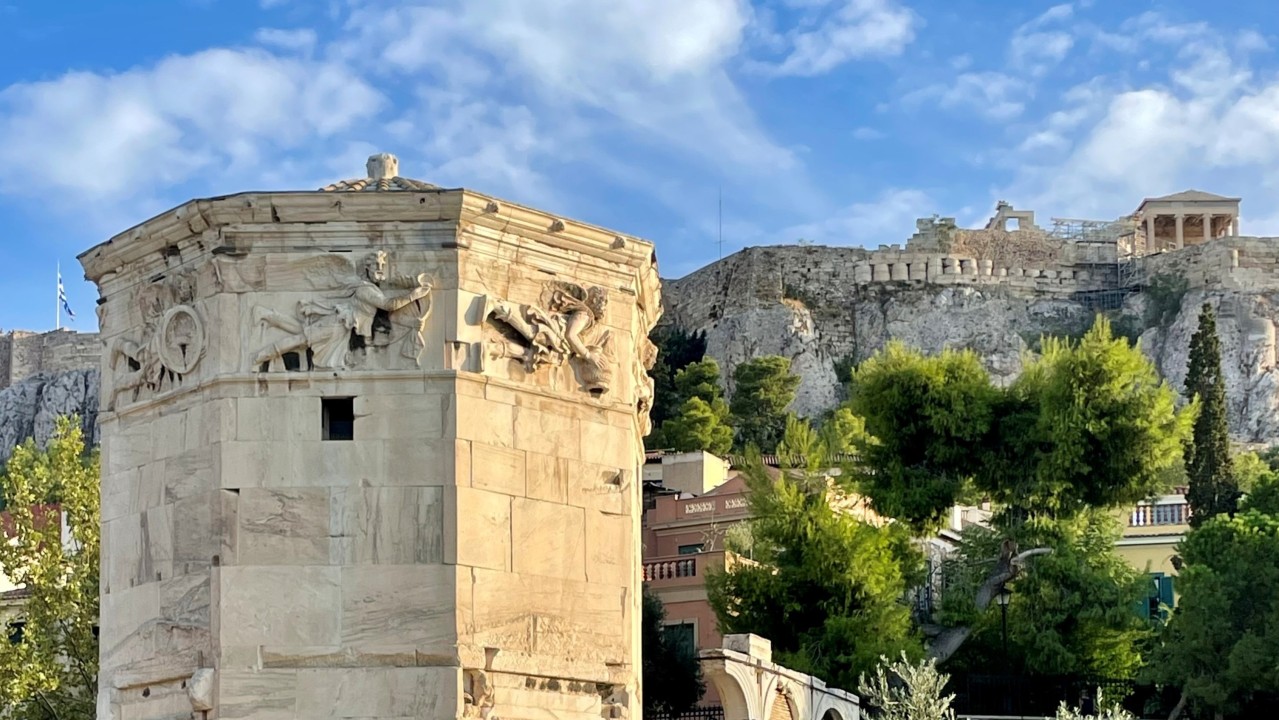
Our family vacation lasted two weeks and took us through four countries and ten cities. Trains, planes, automobiles, boats, and a lot of walking. We climbed hills and fortresses, wandered through churches and ruins, ate more gelato than anyone needed, and tried to ignore the heat. So hot.
We laughed. We got tired. We got on each other’s nerves. It was, in other words, a family vacation.
Somewhere along the way, I kept trying to square the thousands of years surrounding us with the decades we are given. How permanent our own moment can feel when we are living inside it, and how temporary it looks from the other side of history.
Everywhere we went, one civilization seemed to have been built on top of another. Fortresses changed hands. Borders disappeared and reappeared. Empires collapsed. Religious authority competed with political authority. Trade created new centers of influence. Institutions that once seemed permanent eventually became places we walked through on vacation.
What stayed with me wasn’t simply how much had changed. It was how often the source of power had changed with it.
Power rarely disappears. It moves. Sometimes it changes form.
I came home thinking about artificial intelligence.
Much of the conversation about AI is focused on capability and the extraordinary speed of its development. What can the models do? Which jobs will they replace? How much more powerful will they become? What happens when machines can reason, create, diagnose, code, research, and perform tasks that once required years of education or experience?
Those are important questions. But I keep coming back to another one.
Where is power moving?
When Knowledge Becomes Power
In Powershift, Alvin and Heidi Toffler examined how knowledge was becoming a source of power alongside wealth and force. But their argument went further. A powershift was not simply about power passing from one person or institution to another. It could change the nature of power itself.
That distinction feels especially relevant now.
For most of human history, valuable knowledge was difficult to acquire. It might require access to a library, a university, a profession, a laboratory, a government, or simply the right people. Expertise took years to develop, and institutions became powerful partly because they accumulated knowledge others could not easily access.
The internet began breaking down those walls. AI may be doing something different.
The internet opened the library. AI increasingly helps us work with what is inside.
Someone sitting at a kitchen table can ask for an analysis that once required a team. A small company can perform work that previously demanded specialized departments. A scientist can explore connections across disciplines. An entrepreneur can move from idea to prototype with resources that would have been unimaginable a generation ago.
The Tofflers understood that knowledge behaved differently from other sources of power. Wealth can be spent. Force can be exhausted. Knowledge can be shared without requiring its owner to surrender it. They described knowledge as expandable in a way the other sources of power were not.
AI takes that characteristic to a scale they could not have experienced.
The Paradox of AI Power
The systems making all of this possible require enormous amounts of capital, computing infrastructure, energy, data, and technical talent.
AI can distribute capability while concentrating control. An individual may gain capabilities once available only to a large organization while becoming more dependent on the organizations that build and control the underlying systems.
Access and control are not the same thing.
The Tofflers were already thinking about that distinction in Powershift. As knowledge became more widely distributed, they saw control over its quantity, quality, and distribution becoming part of the struggle for power.
Who determines what these systems know, what they can do, and which boundaries they operate within? Who can change those boundaries?
But there is another question. What becomes scarce when answers become abundant?
When Answers Become Abundant
We have been told that knowledge is power. That doesn’t become untrue simply because more people can access it. But it may change where the advantage lies.
Perhaps the scarce resource moves.
Knowing something matters, but so does knowing what to ask, whether an answer is reliable, what may be missing, and why two apparently contradictory pieces of information might both matter. As knowledge becomes more abundant, judgment becomes more valuable.
AI can produce an answer in seconds. It may someday become better at judging what that answer means. But it cannot relieve us of the responsibility for deciding what to do with it.
Fluency can easily be mistaken for wisdom. An answer can be beautifully written, carefully structured, and completely convincing while still being incomplete, biased, or wrong. The faster our tools become, the easier it is to move from question to answer without spending enough time in between.
That space in between matters. It is where we question assumptions and notice what the data doesn’t contain. It is where we ask not simply what can be done, but what should be done.
But even judgment may not be the end of the story.
AI is already becoming better at comparing alternatives, weighing probabilities, identifying risks, and recommending courses of action. If it can increasingly assist with what we think of as judgment, then perhaps judgment isn’t the final scarcity either.
Who decides whether to accept the recommendation? Who determines which values matter? Who sees the circumstance the model missed? Who accepts the consequences when the decision is wrong?
AI can help us know and evaluate, perhaps even decide. But a recommendation, however sophisticated, does not take responsibility for what happens next. We do.
Perhaps that is where power moves next. Not simply to those who know, or even those who judge, but to those who retain the authority to choose and the responsibility for what follows.
The Power to Choose
That brings me back to the trip.
For two weeks, we walked through the remains of worlds in which very different people and institutions once had the authority to decide.
Kings, churches, governments, merchants. The source of authority changed, and with it, who could make decisions that shaped other people’s lives.
History doesn’t tell us what AI will do. But it gives us perspective. It reminds us how permanent our own institutions and assumptions can seem when we are living inside them.
AI is giving us extraordinary new capabilities. But capability is only one form of power. Control over the systems is another. So is the authority to decide what happens next.
Knowledge still matters. Judgment still matters. But as machines become more capable of helping us with both, the harder question may be who retains the authority to choose, and who accepts responsibility for what follows.
I came home with hundreds of photographs. But the thing I keep thinking about isn’t something I took a picture of.
It is the question of who gets to decide.