It began with a passing reference to something called the Maslow-Toffler School of Futuristic Education.
A school? Named after Alvin Toffler? Where was it? Who started it? What were they trying to accomplish?
I had never heard of it. My search revealed that the school had operated in Brentwood, Long Island, during the 1970s and early 1980s. But the information I found raised as many questions as it answered. How had the school come about? What did the Tofflers have to do with it? And what had happened to the people involved?
Another search led to a Facebook group. A message to the group’s administrator brought an unexpected discovery: she was the daughter of John Sherin, one of the school’s co-founders.
She arranged a conversation with her father.
John was in his eighties, but as he began talking about the school, his excitement was unmistakable. He had kept the records documenting how and why the school was created and was eager to share them. More than forty years after the school closed, he still believed in what they had been trying to accomplish. He wondered whether those ideas might be even more important today than they had been in the 1970s.
I hadn’t expected this conversation when I first came across the school’s name. A name in a letter, an unfamiliar face in a photograph, a brief mention in an article. Sometimes a small detail leads nowhere. Other times, it opens an entirely new line of inquiry, introducing people and stories I didn’t know existed.
When Ideas Become Someone Else’s Life
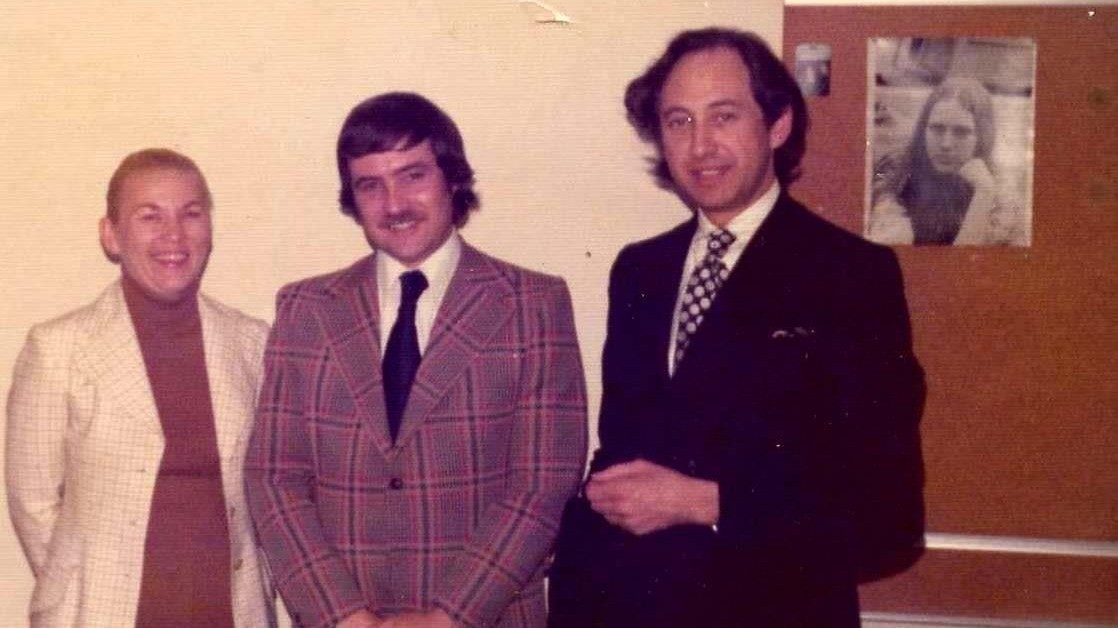
The Maslow-Toffler School of Futuristic Education opened in 1974 as an alternative program within the Brentwood public school system. Teachers John Sherin and Milton Siler developed the proposal when the district struggled with overcrowding and searched for new approaches to education.
Named for psychologist Abraham Maslow and Alvin Toffler, the school brought together ideas about human potential, education, and preparing young people for a changing world.
Students still had to meet graduation requirements, but they could also study futures studies, semantics, and humanistic psychology. The program included independent study, community service, work experience, and performing arts. The program also offered Syracuse University courses through which students could earn transferable college credit. Classes were kept relatively small, allowing greater individual attention.
Not everyone welcomed it. Some parents and educators questioned the unconventional approach and the freedoms students enjoyed. The school attracted both advocates and opponents and operated for nine years before the separate program ended in 1983.
The historical accounts explained what the school offered and how long it operated. John wanted to share something more: why they had created it in the first place.
He had preserved the records from those early years, including the thinking behind the school’s creation. He spoke about students who might flourish in an environment built around curiosity, debate, and the freedom to explore different fields of knowledge rather than being pushed toward narrow specialization.
The school had closed decades earlier, but John hadn’t given up on the ideas behind it.
What People Remember
Alvin and Heidi Toffler spent decades writing about change and the future. Their books reached millions of readers, and their ideas traveled through governments, corporations, universities, and countless conversations.
But behind the books and speeches were thousands of encounters with people whose names rarely appear in accounts of their influence.
As I spoke with people who had known or encountered the Tofflers, I was often surprised by what they remembered. Not necessarily the speeches, books, or meetings that might appear in a biography, but conversations, disagreements, unexpected kindnesses, and moments of encouragement.
Curiosity came up repeatedly in my conversations. So did their enthusiasm for ideas, their desire to engage in debate, their generosity in sharing what they knew, and their kindness.
These recollections offered perspectives I hadn’t encountered during my own years working with Alvin and Heidi. People had known them at different times, under different circumstances, and through relationships quite unlike mine.
They were not indifferent to recognition. They promoted their books, cultivated relationships with influential people, and understood how to reach large audiences. They were ambitious, persistent, sometimes demanding, and far from perfect.
Yet what people remembered often had little to do with those public ambitions.
A conversation that might have been one of hundreds for Alvin or Heidi could remain vivid in someone else’s memory decades later. An exchange of ideas might influence a person’s thinking or work in ways the Tofflers never knew.
Those exchanges also influenced the Tofflers. They sought out people from different disciplines and backgrounds, asked questions, debated ideas, and reconsidered assumptions. Those encounters shaped the Tofflers’ thinking, just as their ideas influenced the people they met.
Some people remembered the famous authors. Others remembered the friends, colleagues, or curious visitors who had taken an interest in their work.
Even after years of working with them, I learned things about Alvin and Heidi I hadn’t known.
Recently, someone watching the film Avanti! noticed a copy of Future Shock on a table. Curious, they looked up the book and read it for the first time. More than fifty years after its publication, they found its ideas remarkably relevant to today’s world and recommended it to everyone.
The Parts of a Life We Never See
Researching the lives of people you knew personally comes with a unique challenge. Familiarity may create the illusion that you already understand much of their story.
Yet the deeper I went into Alvin and Heidi’s past, the more I discovered what had happened before our paths crossed. People who had influenced them, experiences which had formed their thinking, relationships that had endured or faded, and decisions whose significance only became apparent years later.
The discoveries were not always historically consequential. Some were simply fascinating.
A photograph might send me searching for the identity of someone standing beside them. A letter may mention someone whose connection was unclear. An unfamiliar name could lead to another conversation, another document, or another question.
Some discoveries took hours or days to unravel. A detail might send me searching through old documents or trying to locate someone who could answer a question. And when the pieces finally came together, the satisfaction could be enormous, even if the discovery amounted to no more than a paragraph or a footnote.
A reader would not necessarily share that excitement. Nor could every interesting detail become part of the story without overwhelming it.
Some discoveries made it into the manuscript. Many did not.
I think about that conversation with John Sherin. Without a passing reference, a Facebook group, and a daughter willing to make an introduction, I might never have heard his story.
I wonder how many other stories are still out there.